

Non-Binary Top Surgery: Breast Reduction vs Full Removal
Medically reviewed by Briana Smith on March 27, 2026.
Many trans masculine and non-binary patients are not interested in having a completely flat chest after top surgery. At the Gender Confirmation Center (GCC), our team offers a variety of surgical techniques for patients interested in non-flat top surgery results or, alternatively, an aggressive breast reduction (sometimes called a “transgender breast reduction”). One of the main esthetic differences between a breast reduction and a non-flat top surgery is whether or not the remaining tissue has a tear-drop shape. If you are interested in having one of our board-certified surgeons evaluate which technique would best help you achieve your goals, you can request a free, virtual or in-person consultation here.
What is an Aggressive Breast Reduction for Gender Affirmation?
A transgender or non-binary breast reduction is different from a classic breast reduction in that it often involves the removal of more tissue; that’s why it’s sometimes called an “aggressive” reduction. The characteristics of a breast reduction are:
- The chest contour resembles the shape of a teardrop
- Some overhang of tissue and skin is leftover below the incision, which leaves some “bounce” to the chest tissue during body movement
Image A below shows the classic teardrop shape that is usually maintained with a breast reduction. The medical illustration depicts a patient with relatively little fat deposits; however, breast reduction top surgery is available to patients of a wide range of BMIs, not just “skinny” patients.

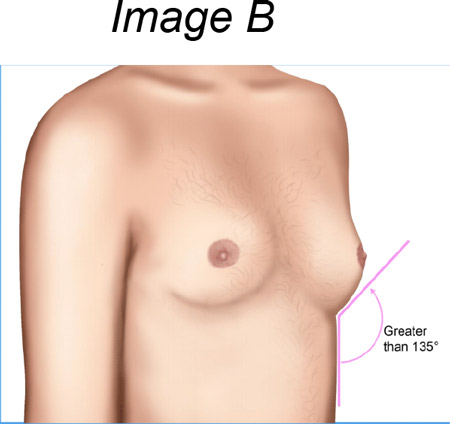
Image B below shows the degree of overhang our surgeons often aim for with an aggressive breast reduction. That said, the amount of tissue we leave behind is left up to the patient. In a free virtual or in-person consultation you can share your goals with a board-certified surgeon. Breast overhang is a component that can really impact someone’s experience of gender dysphoria or discomfort, and the procedure that is chosen should take this into consideration.
Before & After Results
The following photosets demonstrate the variation in non-binary breast reduction. Note that the differences in results aren’t just a matter of patients’ individual anatomy, but also their goals around the amount of tissue left behind:


Aggressive Breast Reduction vs. Other Types of Top Surgery
Generally speaking, we group top surgery into the following three types:
- Chest reconstruction or masculinization
- Aggressive breast reduction
- Breast augmentation or feminization
In terms of technique, a non-binary or transgender breast reduction involves most often an inverted T technique. On the other hand, masculinizing non-flat top surgery can also be accomplished with an Inverted-T technique, though a buttonhole incision, a classic double incision and a double incision with nerve grafting are more common. In the video below, Dr. Jacobs (he/him) explains this difference
Motives for Choosing Between Breast Reduction Top Surgery and other Non-Flat Options
Most of our patient inquiries about non-binary top surgery have to do with chest reconstruction and breast reduction procedures. The difference between the two has to do with the chest contour. Generally speaking, a breast reduction leaves a patient with more breast overhang and a tear-drop shaped chest contour; these are features we discuss more in the following section.
Many of our non-binary patients select a breast reduction because they say it gives them a more “gender fluid look.” In other words, having minimal leftover tissue allows them, in their words, to more easily present feminine on some days and more masculine on others, depending on the fit of their clothes, without needing to wear a chest binder.
Non-Flat Top Surgery Results
On the other hand, a non-flat top surgery result involves leaving some volume behind on a chest, without giving the chest contour a tear-drop or breast-like shape. The images below show what a non-flat top surgery result looks like for patients interested in a masculinizing result:


Non-Flat Top Surgery Techniques
Chest fullness can be achieved either with
- Weight training to develop pectoral muscles
- The placement of silicone pectoral implants; or
- Leaving behind a small amount of tissue so that there is some overhang after surgery
There are two different types of top surgery incisions that are likely to yield a result that is nonflat in appearance: the buttonhole and the Inverted T. Both techniques leave patients an 80% chance of maintaining high levels of sensitivity in their nipples since they retain the nipples’ initial blood and nerve supply.
Buttonhole Top Surgery for Non-Binary Breast Reduction
A buttonhole technique is ideal for patients who have a medium amount of breast tissue starting off. The buttonhole technique leaves behind what we call a “pedicle” a mound of tissue behind the nipple that preserves its initial blood and nerve supply. Since a buttonhole procedure leaves a mound of tissue behind, the chest is not completely flat and may have a “bounce” to it when the patient moves. Still, most often the buttonhole technique does not leave patients with a tear-drop-shaped chest contour.
The buttonhole procedure leaves behind scarring similar to the classic double incision: two horizontal scars at the base of the pectoral and two scars around the circumference of the nipples.
See the examples below:


Inverted T Top Surgery for Non-Binary Breast Reduction
The inverted T or anchor incision is ideal for patients who have a large amount of breast tissue starting off. Like the buttonhole, the inverted T leaves the pedicle behind, and with it, the nipples’ original nerve and blood supply.
The incision gets its name from the inverted T or anchor-shaped scar it leaves behind: with two vertical lines that connect the areolas to the two horizontal scars at the inframammary fold. See the image below for reference:
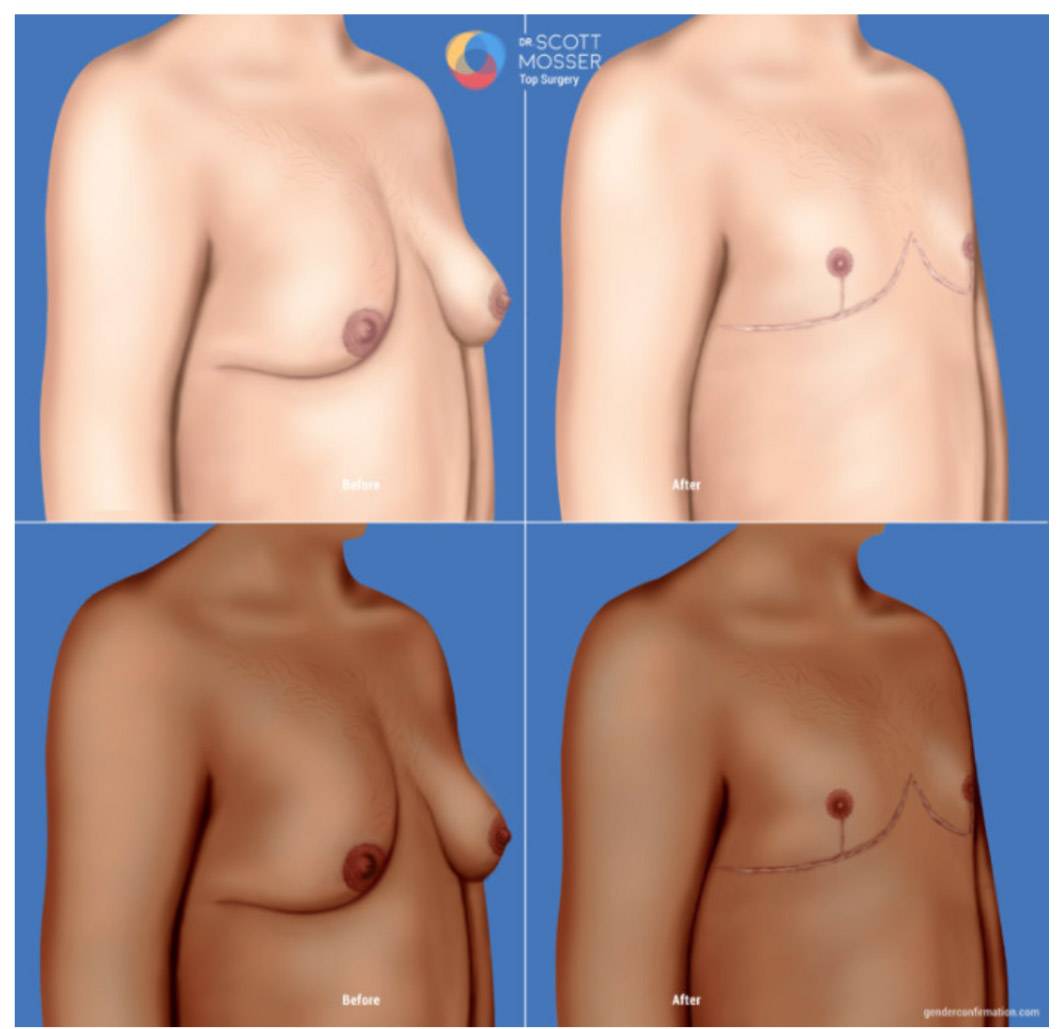
The extra vertical incision in the inverted T technique makes it easier for your surgeon to leave behind tissue in a tear-drop breast-like shape.
See the example below:


Frequently Asked Questions
How much does non-binary top surgery cost? Will insurance cover my procedure?
Top surgery can cost anywhere from $8,500 – $11,500, in addition to other associated costs like facility and/or hospital fees. Some insurance providers will cover gender-affirming surgery. If you have a plan that has transgender benefits, you will need to get a support letter from a licensed mental health professional to qualify for coverage.
Will I lose nipple sensation after a breast reduction?
The buttonhole, inverted T and double incision with nerve grafting techniques give patients about an 80% chance of retaining the same level of sensibility in their nipple-areolar complex after surgery. That means that there is a relatively small risk of losing some or all sensation in one or both nipples. Nerve rehabilitation exercises can help patients recover sensation as they recover.
Is hormone replacement therapy (HRT) a requirement for non-binary top surgery?
At the Gender Confirmation Center (GCC), we do not require that patients undergo HRT to qualify for surgery. Additionally, insurance providers that cover gender-affirming surgery tend not to require HRT for patients who are interested in undergoing chest reconstruction or breast reduction top surgery.
Is breast reduction the same as top surgery?
Generally speaking, breast reduction surgery can be classified as a medically necessary procedure for two reasons: (1) to address a physiological problem, like chronic back pain, resulting from breast size and (2) to treat a patient’s gender dysphoria. When a breast reduction is designed to help a patient experience greater gender alignment with their body, we would group this surgery into the broader gender-affirming top surgery category.
In Summary
- Aggressive breast reductions are performed on patients who wish to maintain some elements of the teardrop shape and minimal breast overhang, and are okay with a bit of movement of the chest (i.e. “bounce”) after surgery.
- Top surgeries with a non-flat result are most commonly performed using a buttonhole or inverted T incision. Patients can also opt for silicone pectoral implants or weight training to increase the volume of their chest.
- You can speak with one of our board-certified surgeons in a free, virtual or in-person consultation to create a unique-surgical plan tailored to your goals and anatomy.
Click Here to Request the Next Steps to Schedule a Consult!
We offer complimentary virtual and in-person consultations with our board-certified surgeons. Click here to complete our consultation request form to learn more about the next steps in your patient journey.
BOOK CONSULTATION
Suite 1010, 450 Sutter St
San Francisco, CA 94108
Phone: (415) 780-1515
Fax: (628) 867-6510
GCC business hours are from 9:00 am to 4:00 pm
GCC phone hours are from 9:00 am to 4:00 pm
GCC phone hours are from 9:00 am to 4:00 pm
Board Certification
& Memberships
Copyright © 2023 GCC (Gender Confirmation Center). All Rights Reserved.